Best Canadian Ski Towns: 9 Mountain Communities Worth the Trip

Canada builds ski towns the way it builds everything else — with an abundance of space, an indifference to modesty, and enough annual snowfall to make the Alps look temperate. The nine towns in this guide span four provinces, two mountain ranges, and a surprising variety of personalities. Some are cosmopolitan resort villages. Others are former mining or logging settlements that discovered powder as a second act. What they share is a depth of snow, a lack of pretension, and a quality of terrain that consistently draws skiers who have skied everywhere else. This guide compares them by snowfall, vertical, ski area size, town character, and the kind of trip each one suits best.
How Canadian Ski Towns Compare: The Quick Reference
Before choosing a town, it helps to see the numbers side by side. The table below compares all nine on the metrics that matter most when planning a Canadian ski trip.
| Town | Province | Vertical (m) | Skiable Terrain | Avg Snowfall | Best For |
|---|---|---|---|---|---|
| Whistler | BC | 1,609 | 3,307 ha | 1,164 cm | All-rounders, village life |
| Revelstoke | BC | 1,713 | 1,263 ha | 1,049 cm | Advanced skiers, powder |
| Fernie | BC | 1,082 | 1,013 ha | 875 cm | Intermediates, town culture |
| Kicking Horse | BC | 1,260 | 1,133 ha | 750 cm | Expert terrain, day-tripping |
| Big White | BC | 777 | 1,147 ha | 750 cm | Families, ski-in ski-out |
| Sun Peaks | BC | 882 | 1,678 ha | 600 cm | Families, uncrowded skiing |
| Banff / Lake Louise | AB | 1,000 | 1,700 ha | 360 cm | Scenery, multi-resort variety |
| Jasper / Marmot Basin | AB | 914 | 688 ha | 400 cm | Solitude, national park setting |
| Mont-Tremblant | QC | 645 | 305 ha | 394 cm | East coast skiers, Québécois culture |
Whistler: The Standard-Bearer
Whistler Blackcomb is the largest ski resort in North America by skiable area — 3,307 hectares across two mountains connected by the Peak 2 Peak Gondola, with 1,609 metres of vertical drop. It receives an average of 1,164 centimetres of snow per season, enough to keep its alpine bowls rideable well into May.
The village at the base is a purpose-built pedestrian district that manages the trick of feeling walkable without feeling artificial. Restaurants, shops, and hotels line a car-free central corridor. The dining scene is genuinely strong — Japanese, Italian, West Coast seafood, and the kind of après-ski bars where conversations between lift-served runs turn into late evenings.
Whistler draws every type of skier. The groomers on Whistler Mountain suit intermediates. Blackcomb's Glacier and Horstman zones deliver steep chutes and glacier skiing. The backcountry gates open to terrain that rivals anything in British Columbia's interior. Explore chalets in Whistler and you will find properties that reflect the resort's dual personality — family-friendly lodges and design-forward residences for those who treat the village as a base for more ambitious terrain.

The trade-off is proximity to Vancouver. A two-hour drive on the Sea-to-Sky Highway brings weekend crowds. Midweek visits in January and February are quieter, and the upper-mountain alpine terrain rarely feels congested regardless.
Revelstoke: The Powder Town
Revelstoke holds the North American record for vertical drop at a lift-served resort — 1,713 metres from peak to base, with 1,049 centimetres of average annual snowfall. The resort is younger than most entries on this list, having opened its modern lift-served terrain in 2007, but the town itself has operated as a railway and forestry hub since the 1880s.
The skiing is demanding and rewarding. Revelstoke's reputation rests on its gladed tree skiing and steep sub-alpine bowls — North Bowl, South Bowl, and the Ripper chair zone deliver consistent fall-line terrain through old-growth cedar and hemlock forest. The groomed runs exist, and they are long, but this is not the mountain for someone who stays on-piste exclusively.
The town of Revelstoke sits in the Columbia River valley, a 10-minute drive from the resort base. It has the feel of a mountain community that skis rather than a resort that built a town. The main street hosts independent coffee shops, craft breweries, and restaurants that would not seem out of place in a larger city. Browse properties in Revelstoke for a trip that prioritises deep snow and authentic small-town character over resort-village polish.
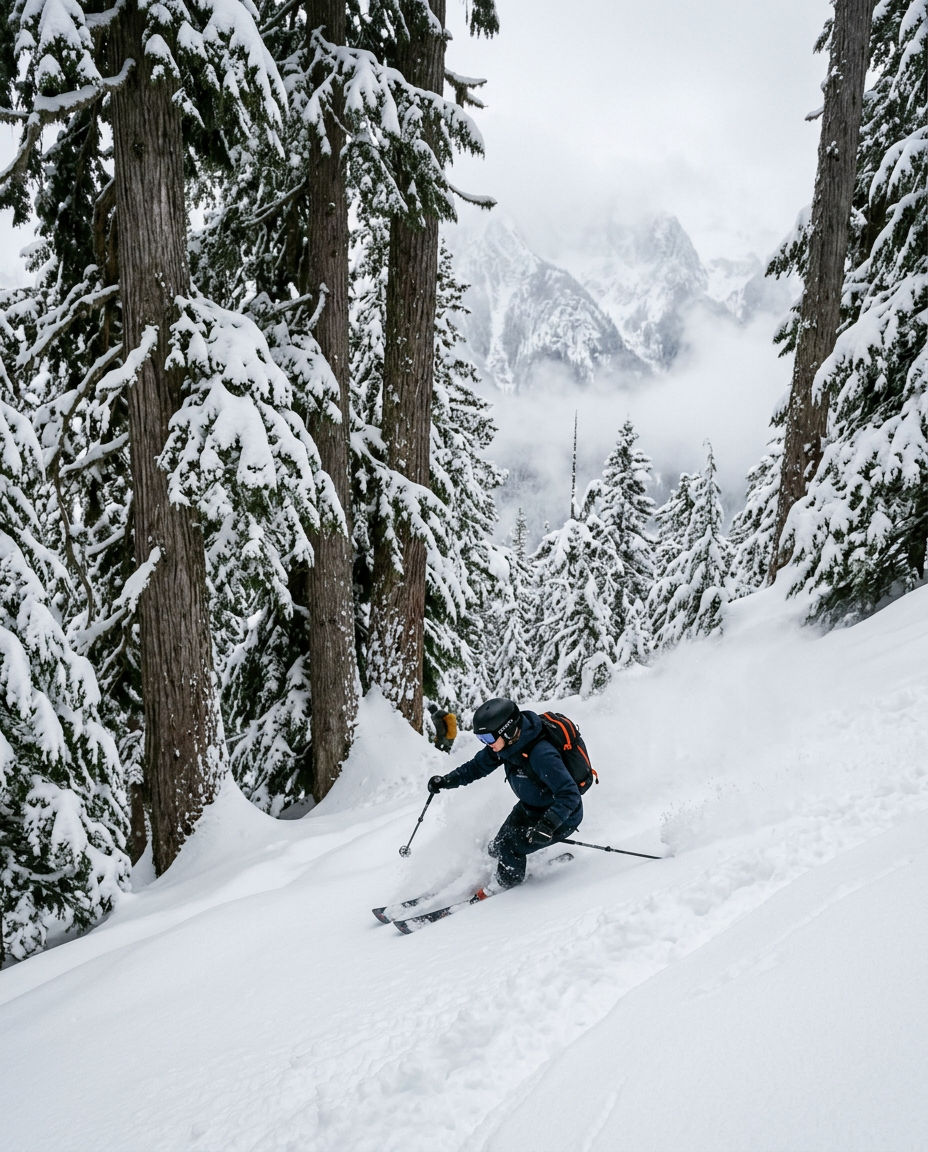
Cat-skiing and heli-skiing operators work the surrounding Selkirk and Monashee ranges. Revelstoke is one of the few places in the world where you can ski lift-served, cat-ski, and heli-ski from the same base town in the same week.
Banff and Lake Louise: The Rockies Icons
Banff and Lake Louise together form the most recognisable ski destination in Canada — two towns and three ski areas (Banff Sunshine, Lake Louise, and Mt Norquay) inside Banff National Park, all accessible on a single SkiBig3 pass. Lake Louise's terrain spans 1,700 hectares with views of the Victoria Glacier. Banff Sunshine sits at 1,660 metres base elevation — the highest base in the Canadian Rockies — delivering dry, cold snow and a long season that often extends into late May.
The town of Banff itself is a National Historic Site and a genuine year-round community. It has a permanent population of around 8,000, a walkable main street (Banff Avenue) lined with restaurants, galleries, and outfitters, and the kind of independent shops that survive because locals use them too. Lake Louise village is smaller and quieter — a cluster of lodges near the lake and the Fairmont Chateau.
The scenery in this corridor is extraordinary by any standard. Lake Louise's front face looks out across a glacial valley to peaks above 3,000 metres. Banff Sunshine's summit opens to panoramic views of the Continental Divide. Explore properties in Banff to find accommodation that places you within the national park, where elk wander the streets at dusk and the Trans-Canada Highway cuts through valleys flanked by 3,000-metre walls.
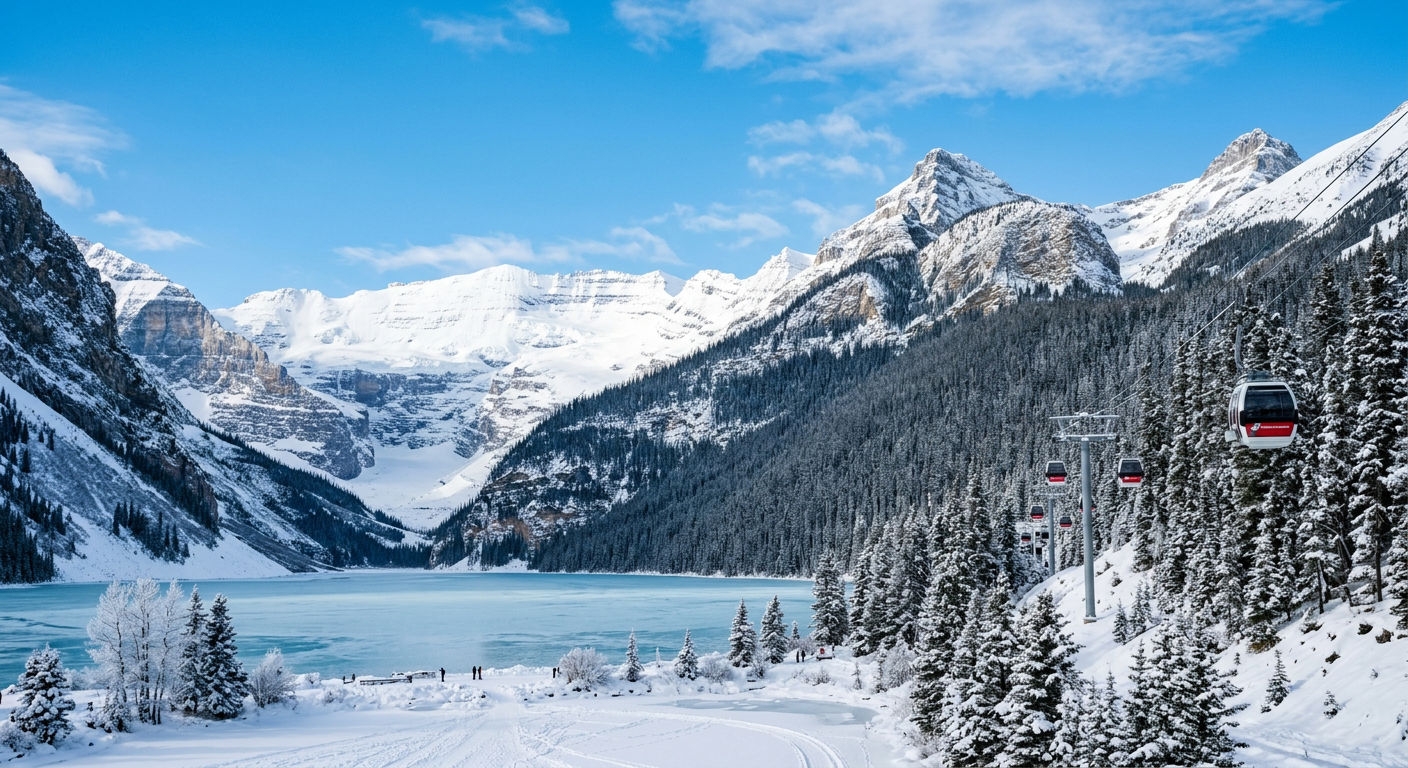
The air here is dry and cold — temperatures regularly dip below −20°C in January and February. The snow is light and powdery as a result, but the wind-exposed terrain at Sunshine can feel raw on frigid days.
Fernie: The Undercurrent
Fernie Alpine Resort receives an average of 875 centimetres of snow per season — a figure that consistently places it among British Columbia's snowiest — and sits above a town of 6,000 that operates with the unhurried confidence of a place that has never tried to be anything other than what it is. Originally a coal-mining town founded in 1898, Fernie pivoted to skiing in the 1960s and has grown steadily without losing its working-town character.
The ski area covers 1,013 hectares across five bowls, with terrain split relatively evenly between groomed intermediate runs, advanced bowl skiing, and gladed tree lines. Cedar Bowl and Currie Bowl offer steep, sheltered powder skiing after storms. Lizard Bowl opens to longer, more sustained descents. The resort's north-facing aspect preserves snow quality through the season.
Downtown Fernie — Second Avenue in particular — has more personality per block than many larger mountain towns. Craft breweries (Fernie Brewing is a regional institution), independent restaurants, a heritage hotel, and a community arts centre create a social life that exists independently of the ski hill. Browse chalets near Fernie if your priority is a ski town that feels lived-in, with skiing that quietly competes with its more famous neighbours.
Fernie is a five-hour drive from Calgary, which keeps it insulated from weekend crowds. The locals like it that way.
Sun Peaks: The Quiet Giant
Sun Peaks is Canada's second-largest ski resort by skiable area — 1,678 hectares across three mountains — yet it operates at a fraction of the visitor volume of comparably sized resorts. Average annual snowfall is approximately 600 centimetres, and the 882 metres of vertical provide a satisfying range from gentle beginner runs to sustained intermediate groomers and a small zone of genuine steeps on Mt Morrisey.
The village is compact, purpose-built, and almost entirely ski-in ski-out. It was designed in the mid-1990s with a pedestrian core, and the layout works — you can ski to breakfast, return to your accommodation at lunch, and never touch a car for the duration of your stay. Explore properties at Sun Peaks for a ski trip that strips away the friction of transfers, shuttles, and parking lots.
Sun Peaks suits families and intermediate skiers particularly well. The terrain is well-groomed, the lift lines are rare, and the village scale makes it easy to manage with children. Advanced skiers will find enjoyable terrain on Gil's and the Headwalls, but this is not the destination for someone chasing steep chutes or deep powder.
The resort sits 45 minutes north of Kamloops, British Columbia. Direct flights to Kamloops from Vancouver and Calgary reduce the access challenge.
Kicking Horse: The Steep Specialist
Kicking Horse Mountain Resort near Golden, British Columbia, is built for skiers who want sustained vertical on steep, open terrain. With 1,260 metres of vertical, 1,133 hectares of skiable area, and a reputation anchored by its expert-rated upper mountain, Kicking Horse draws a particular type of visitor — one who considers a groomed blue run a way to rest between bowls.
The upper mountain — accessed by the Golden Eagle Express Gondola — delivers wide-open alpine bowls, chutes, and ridgeline descents. CPR Ridge, Terminator Peak, and Super Bowl are names that appear in lists of North America's most challenging in-bounds terrain. The lower mountain offers intermediate groomers, but the resort's identity is defined by what happens above treeline.
The town of Golden sits at the confluence of the Kicking Horse and Columbia rivers, a 15-minute drive from the resort. It is a working town rather than a resort village — lumber, rail, and tourism share the economy. The dining and nightlife are modest but genuine. Browse properties near Kicking Horse if you value quality terrain over après-ski polish.
Kicking Horse's position between Banff and Revelstoke (both roughly 90 minutes away) makes it a strong addition to a multi-resort Rockies itinerary.
Big White: The Family Constant
Big White Ski Resort, 56 kilometres southeast of Kelowna, receives an average of 750 centimetres of annual snowfall across 1,147 hectares. It is the Okanagan's flagship ski destination and Canada's largest fully ski-in ski-out resort — the entire village is accessible on skis.
The terrain spans a broad range from gentle beginner zones to genuine advanced runs through the Black Forest glades, but the resort's centre of gravity sits firmly in the intermediate space. Long, well-groomed cruisers like the Cliff and Gem Lake runs make Big White one of the most enjoyable carving mountains in British Columbia.
The village itself is compact and family-oriented. An outdoor ice-skating rink, tube park, and horse-drawn sleigh rides operate alongside the usual restaurants and rental shops. Explore chalets at Big White for a trip where convenience dominates — park the car on arrival and do not touch it again until departure.
Direct flights to Kelowna from Vancouver, Calgary, and seasonal routes from other Canadian cities make Big White one of the most accessible interior BC resorts. The "snow ghost" formations — trees encased in thick rime ice at the summit — are unique to this mountain and worth the gondola ride alone.
Mont-Tremblant: The Eastern Standard
Mont-Tremblant is the largest ski resort in Eastern Canada and one of the oldest in North America, having operated since 1939. Its 645 metres of vertical and 305 hectares of terrain are modest by Rockies or BC standards, but the resort compensates with a pedestrian village that is among the most visually distinctive in Canadian skiing — colourful Québécois facades lining cobblestone lanes at the mountain's base.
The skiing suits intermediates and confident beginners. The runs on the south side offer consistent grooming and moderate pitch. The north side — the Versant Soleil — delivers steeper terrain with better sun exposure. Snowmaking covers a large percentage of the trail network, ensuring season-long coverage even when natural snowfall, averaging 394 centimetres, falls short.
The village operates with a distinctly Québécois rhythm. French is the working language. The restaurants serve poutine alongside duck confit. The cultural programme — live music, holiday markets, outdoor festivals — is more developed than at any other eastern Canadian resort. Browse properties in Mont-Tremblant for a ski trip where the village experience carries as much weight as the skiing itself.

Mont-Tremblant sits 130 kilometres north of Montréal, making it accessible for weekend trips from Canada's second-largest city. Direct flights to Montréal-Trudeau from across North America and Europe simplify the journey for international visitors.
Jasper and Marmot Basin: The National Park Retreat
Marmot Basin, Jasper's ski area, is the most isolated lift-served resort on this list — a 20-minute drive from the Jasper townsite deep inside Jasper National Park. With 914 metres of vertical, 688 hectares of terrain, and an average snowfall of roughly 400 centimetres, it is not the largest or deepest-snow resort in the Rockies. What it offers instead is solitude.
On a midweek January morning, it is possible to ski Marmot Basin's upper zones — the Knob, Charlie's Bowl, the Eagle Ridge chutes — with the mountain essentially to yourself. The skiing is honest and unpretentious: a mix of open bowls, groomed intermediates, and enough expert terrain to hold interest for three or four days.
The town of Jasper has approximately 4,000 permanent residents and a feel that sits halfway between a mountain hamlet and a national park base camp. Elk wander the streets (a daily reality, not a tourist gimmick). The restaurants and bars are unpretentious. The Fairmont Jasper Park Lodge, set on Lac Beauvert, adds a layer of refinement without altering the town's character. Explore properties near Jasper if your definition of a ski town starts with quiet.
The Icefields Parkway, which connects Jasper to Lake Louise, is one of the great alpine drives in the world. Combining Jasper and Banff into a single trip — two national park towns, three ski areas, and 230 kilometres of glacial scenery between them — is a compelling way to experience the Canadian Rockies.
Explore Canadian Ski Towns with Powder Edition
Powder Edition brings together a curated collection of ski properties across Canada's finest mountain towns. Explore our collection in Whistler, Revelstoke, Banff, or browse all Canadian destinations to find accommodation that matches your terrain preferences and travel style.
Frequently Asked Questions
What is the best Canadian ski town for powder?
Revelstoke leads Canadian ski towns for powder skiing, with 1,049 centimetres of average annual snowfall and 1,713 metres of vertical — the highest in North America. Its gladed tree runs and sub-alpine bowls hold snow well between storms. Fernie (875 cm average) and Whistler (1,164 cm) are strong alternatives, each with different terrain profiles.
Which Canadian ski town is best for families?
Big White and Sun Peaks are the two strongest family options. Both offer fully or near-fully ski-in ski-out villages, consistent intermediate grooming, short transfer times from regional airports, and on-mountain amenities (tube parks, ice rinks) that keep children occupied off the slopes. Mont-Tremblant is the best eastern option for families, with a walkable village and reliable snowmaking.
How does Canadian skiing compare to the Alps?
Canadian resorts generally receive more natural snowfall than Alpine equivalents — Revelstoke's 1,049 cm dwarfs Chamonix's 600 cm average — but offer less interconnected lift infrastructure. Ski areas in Canada are typically single-resort operations rather than the multi-valley linked systems common in France and Austria. Canadian ski towns tend to be more relaxed and less formal than their European counterparts, with lower dining costs and less emphasis on structured après-ski culture.
When is the best time to ski in Canada?
The Canadian ski season typically runs from late November to mid-April, with peak conditions in January through March. January and February deliver the coldest temperatures and driest powder in the Rockies and interior BC. March brings longer days, warmer temperatures, and excellent spring snow at higher elevations. Whistler and Banff Sunshine often extend into May in strong snow years.
What is the most affordable Canadian ski town?
Fernie, Kicking Horse, and Jasper consistently rank among the more affordable options. Lift tickets at Marmot Basin (Jasper) cost roughly 30–40% less than at Whistler. Fernie and Kicking Horse offer lower accommodation and dining costs than the major resort villages. Big White and Sun Peaks occupy a middle ground — purpose-built villages with premium accommodation but lower price points than Whistler or Banff.
Do I need a car to ski in Canada?
It depends on the town. Whistler, Mont-Tremblant, Big White, and Sun Peaks all function well without a car — the villages are walkable and ski-in ski-out. Banff has a shuttle system connecting the town to all three ski areas. Revelstoke, Fernie, Kicking Horse, and Jasper generally benefit from a rental vehicle, as the ski areas sit outside the town centres.