Ski Towns in Switzerland: 9 Alpine Villages Worth the Trip

Switzerland invented the ski holiday. While other alpine nations built resorts, the Swiss refined something more lasting: mountain towns where the skiing, the architecture, and the daily rhythm of life exist in a balance that hasn't been replicated elsewhere. A ski town in Switzerland is rarely just a base for the lifts — it's a place with its own gravitational pull, where the village itself is part of the reason to visit.
But choosing the right one matters. Zermatt and St. Moritz attract different crowds for different reasons. Verbier and Andermatt offer fundamentally different skiing experiences. And the quieter towns — Wengen, Saas-Fee, Grindelwald — deliver something the marquee names sometimes sacrifice: a sense of calm that the mountains deserve.
What Makes Swiss Ski Towns Different
Swiss ski towns distinguish themselves through infrastructure, not spectacle. The country's rail network connects most major ski areas to international airports within three hours, often without requiring a car. Many of the best towns — Zermatt, Wengen, Saas-Fee — ban motor vehicles entirely, creating an atmosphere that larger resort developments spend millions trying to manufacture.
The skiing itself benefits from Switzerland's position at the heart of the Alps. Elevations run higher than most Austrian or French resorts, with glacial terrain extending the season into late spring. The Matterhorn Glacier Paradise reaches 3,883 metres; Saas-Fee's Allalin glacier sits at 3,500 metres. These aren't marketing numbers — they're the reason Swiss resorts maintain snow when lower-altitude neighbours struggle.
Accommodation in Swiss ski towns tends toward the considered rather than the conspicuous. Design-forward chalets and historic hotels outnumber the purpose-built apartment blocks that dominate French mega-resorts. The scale remains human. You can walk from one end of most Swiss ski villages in fifteen minutes, and the bakery that's been open since 1920 still sets the morning schedule.
Zermatt: The Definitive Swiss Ski Town
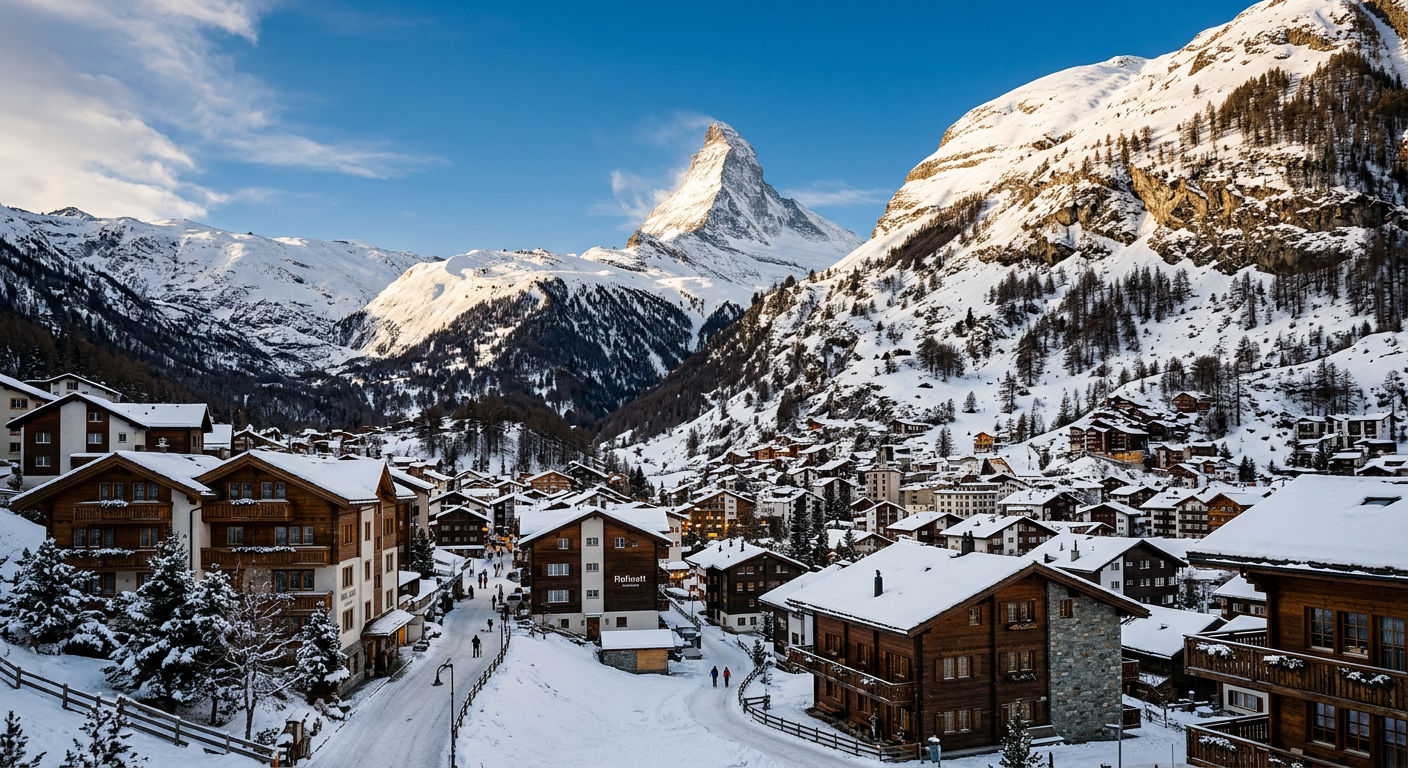
Zermatt is the ski town against which all others are measured — and it earns the comparison. Car-free since before the concept became fashionable, the village sits at 1,620 metres beneath the Matterhorn, with a ski area spanning 360 kilometres of pistes shared with Cervinia across the Italian border.
The terrain covers every ability level, but Zermatt's distinction lies in its high-altitude skiing. The Klein Matterhorn lift reaches 3,883 metres, making it the highest ski station in the Alps. Snow conditions remain reliable from November through late April, and glacier skiing extends into summer.
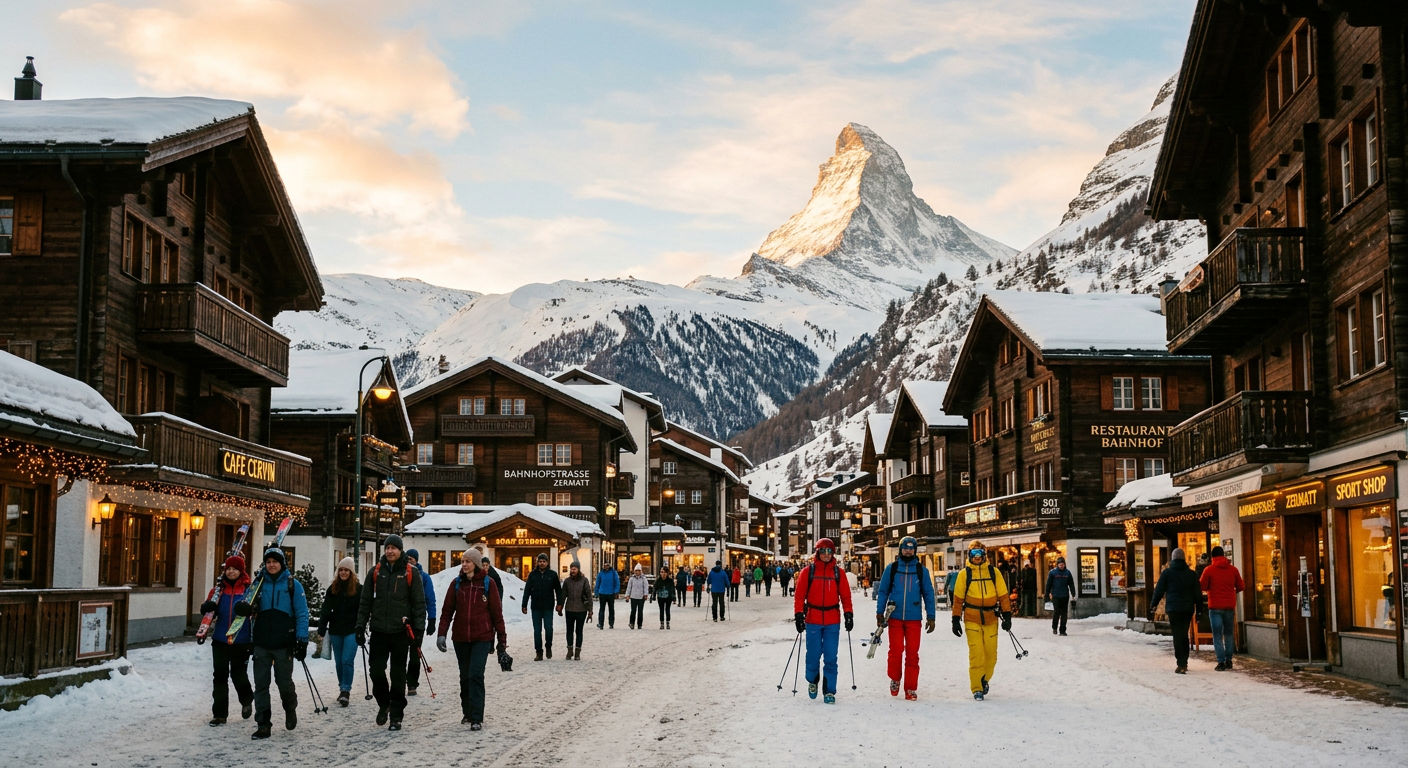
The village itself has evolved without losing its identity. Bahnhofstrasse — the main street — mixes Michelin-starred restaurants with traditional Walliser wine bars. Timber chalets line the older quarters, and the car-free policy means electric taxis and horse-drawn carriages replace the traffic that congests other resort towns.
Explore chalets in Zermatt for a sense of what's available — from contemporary slope-side apartments to restored 19th-century farmhouses.
| Feature | Detail |
|---|---|
| Altitude | 1,620m village, 3,883m top station |
| Piste kilometres | 360 km (shared with Cervinia) |
| Lifts | 52 |
| Season | November – April (glacier: year-round) |
| Car-free | Yes |
| Nearest airport | Geneva (3h 40m by train), Zurich (3h 30m) |
Verbier: Freeride Capital of the Alps
Verbier's reputation rests on its off-piste terrain, and the reputation is deserved. The Mont Fort glacier (3,330m), the Bec des Rosses face — host of the Freeride World Tour finals — and the vast backcountry accessed from the Mont Gele lift make this the resort serious skiers return to year after year.
But Verbier is more than its steeps. The village sits on a sun-drenched terrace at 1,500 metres with views across the Val de Bagnes to the Grand Combin massif. The 4 Vallees ski area links 410 kilometres of pistes, though Verbier's own sector offers the most rewarding skiing.
The town has a younger, more international energy than Zermatt or St. Moritz. Restaurants range from Michelin-starred Le Rouge to convivial wine bars on the Rue de Medran. The nightlife is the liveliest in the Swiss Alps — though it's the kind of liveliness that suits a 40-year-old with a good wine list, not a budget spring break.
Browse our collection in Verbier — the chalets here tend toward the architectural, with floor-to-ceiling glass and open-plan living designed around the views.

St. Moritz: Where Alpine Skiing Began
St. Moritz holds a singular position in ski history: this is where winter tourism started. In 1864, hotelier Johannes Badrutt wagered a group of British summer guests that they'd enjoy the Engadin winter as much as the summer. They came, they stayed, and the winter holiday was born.
The resort operates on a scale that few mountain towns attempt. Two separate ski areas — Corviglia and Corvatsch — offer 350 kilometres of prepared runs. The frozen lake hosts horse racing, polo, and cricket. Palace hotels line the shore. It's refined without apology, and the skiing — particularly the Corvatsch side — is consistently underrated.
St. Moritz suits skiers who value the complete experience: morning runs on immaculate groomers, a long lunch on a south-facing terrace, and an evening that unfolds through the town's restaurants and hotels with the kind of unhurried elegance that can't be manufactured. Explore properties in St. Moritz.
Grindelwald: The Eiger's Front Row
Grindelwald sits directly beneath the Eiger's north face — one of the most dramatic settings in alpine skiing. The village has been welcoming travellers since the early 19th century, and it shows in the best sense: there's an ease and authenticity here that purpose-built resorts spend decades trying to develop.
The opening of the V-Bahn gondola in 2020 transformed access to the Jungfrau ski region. The Eiger Express reaches Eigergletscher station in just 15 minutes, connecting Grindelwald to the combined Grindelwald-Wengen ski area with 250 kilometres of runs and terrain up to 2,970 metres.
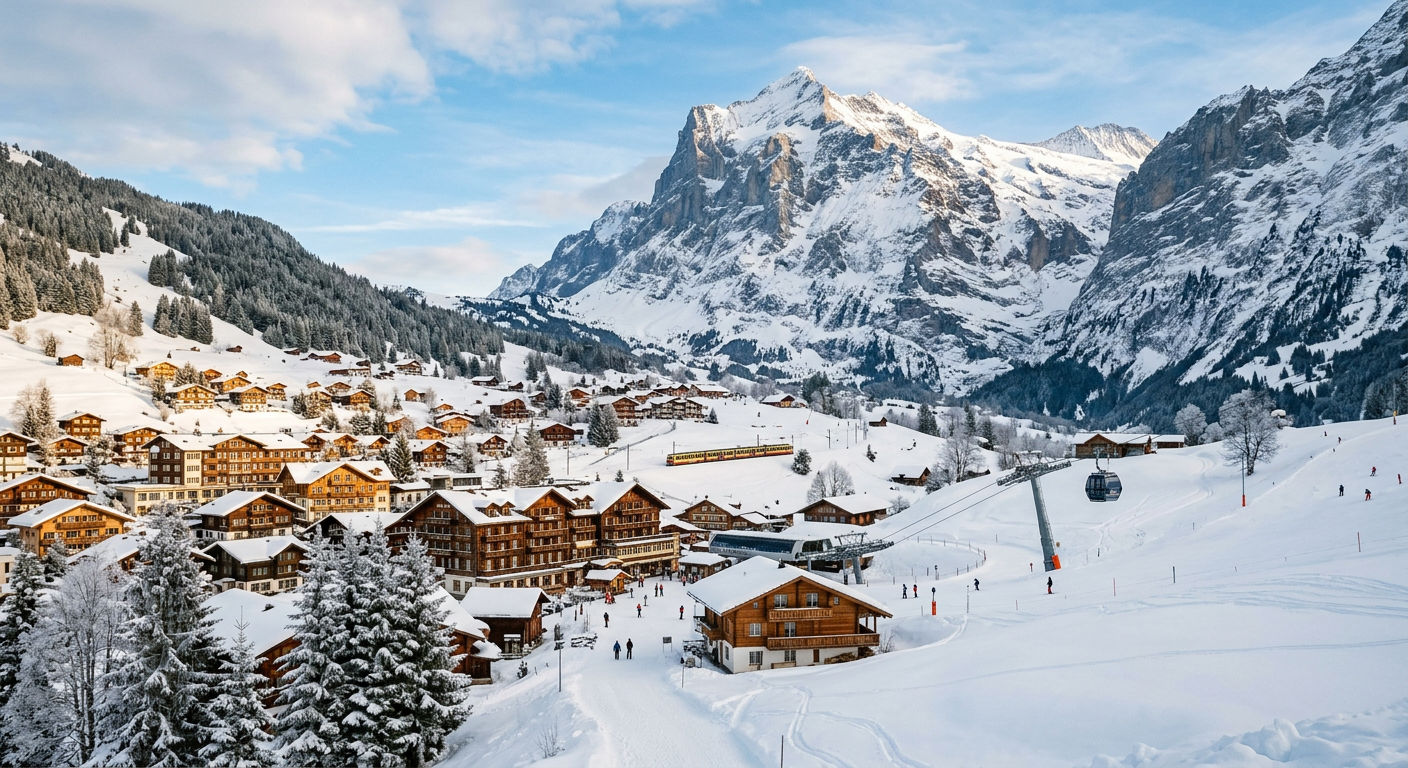
Grindelwald works particularly well for mixed groups. The terrain spans gentle nursery slopes to the genuinely challenging runs beneath the Eiger, and the village offers enough restaurants, shops, and walking trails to occupy non-skiers comfortably. The Jungfrau railway — climbing to the highest station in Europe at 3,454 metres — is worth a day off the slopes.
Wengen: The Car-Free Village Above the Clouds
Wengen occupies a sun terrace at 1,274 metres above the Lauterbrunnen valley, accessible only by the Wengernalp railway. No cars reach the village — and none ever have. The result is a quietness that registers physically: you hear cowbells, train wheels, and the creak of timber, but not engines.
The village shares the Jungfrau ski area with Grindelwald, including the legendary Lauberhorn downhill course — the longest on the World Cup circuit at 4.5 kilometres. But Wengen's appeal is as much about atmosphere as athletics. The Edwardian-era hotels, the car-free promenades, and the views across to the Jungfrau massif create something closer to a mountain retreat than a ski resort.
For skiers seeking the antidote to crowded, car-clogged resort towns, Wengen delivers it without pretension.
Andermatt: Switzerland's Quiet Renaissance
Andermatt has undergone the most significant transformation of any Swiss ski town in the past decade. The Andermatt Swiss Alps development — led by Egyptian investor Samih Sawiris — added a Chedi hotel, new residences, and a gondola linking Andermatt's Gemsstock area to the Sedrun-Disentis ski domain.
The combined SkiArena now spans 180 kilometres of pistes across two distinct mountains. Gemsstock (2,961m) remains one of Switzerland's finest freeride mountains — steep, north-facing, and reliably holding powder days after a storm. The Sedrun side offers gentler, wider runs suited to intermediates and families.
What Andermatt has preserved — and this is the measure of the development's success — is its identity as a quiet Urseren valley town. The Gotthardstrasse still functions as a real village street. The old timber houses haven't been replaced. The Chedi sits at one end of town with understated authority, but it hasn't overwhelmed the surroundings. Explore properties in Andermatt.
Saas-Fee: The Glacier Village
Saas-Fee earns the nickname "Pearl of the Alps" through geography rather than marketing. The village sits in a bowl surrounded by eighteen 4,000-metre peaks — the highest concentration of such peaks in the Alps. It's car-free, glacier-served, and high enough (1,800m) to guarantee snow conditions that lower resorts envy.
The Metro Alpin, the world's highest funicular, climbs to 3,500 metres on the Allalin glacier. Skiing here runs from late November through late April, with glacier skiing available much of the year. The terrain is best suited to intermediates and confident beginners, with wide, well-groomed runs and reliable visibility at altitude.
Saas-Fee's village is compact and walkable, with a selection of hotels and restaurants that punch above their weight for a town of this size.
Davos-Klosters: Alpine City Meets Royal Retreat
Davos and Klosters share a ski area but not a personality. Davos is Switzerland's highest city (1,560m) — urban, international, and known as much for the World Economic Forum as for its skiing. Klosters, ten minutes down the valley, is the quieter counterpart favoured by the British royal family for decades.
The Parsenn ski area connects both towns with 300 kilometres of pistes and some of the longest descents in Switzerland. The Weissfluhjoch-to-Klosters run drops 2,000 vertical metres over 12 kilometres — one of the great alpine descents.
Davos suits skiers who want urban amenities — concert halls, a cinema, diverse restaurants, cross-country trails — alongside their downhill. Klosters suits those who'd rather not. Both work.
How to Choose the Right Swiss Ski Town
| Town | Best For | Terrain Level | Village Character | Budget Level |
|---|---|---|---|---|
| Zermatt | All-round excellence | All levels | Historic, car-free | High |
| Verbier | Off-piste, nightlife | Advanced | International, lively | High |
| St. Moritz | Culture, groomed skiing | Intermediate-advanced | Cosmopolitan | Very high |
| Grindelwald | Dramatic scenery, families | All levels | Traditional, accessible | Moderate-high |
| Wengen | Tranquility, car-free | Intermediate | Edwardian charm | Moderate |
| Andermatt | Freeride, modern luxury | Advanced | Quiet renaissance | Moderate-high |
| Saas-Fee | Reliable snow, glacier | Beginner-intermediate | Compact, car-free | Moderate |
| Davos | Urban amenities, long runs | All levels | City atmosphere | Moderate-high |
| Klosters | Understated quality | Intermediate-advanced | Discreet, refined | High |
Getting to Swiss Ski Towns
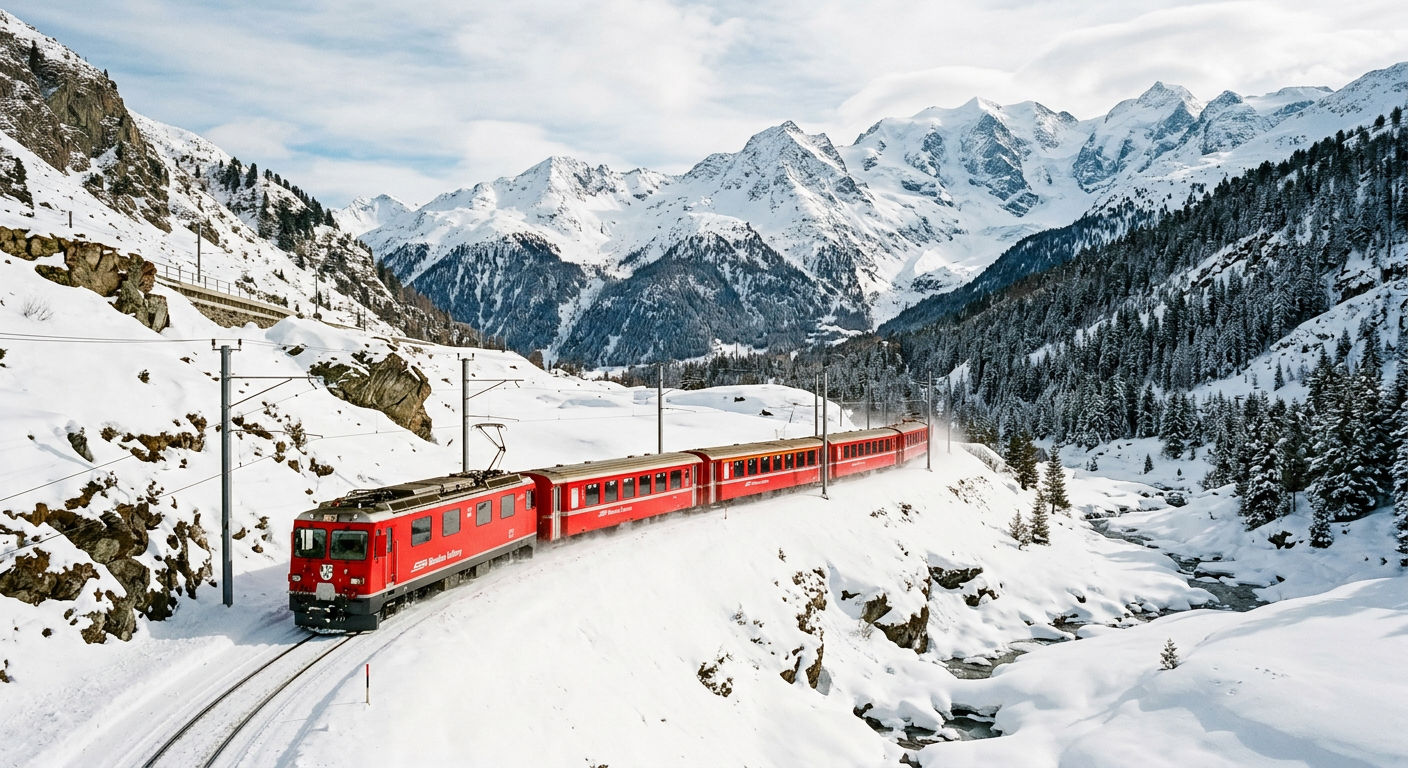
Switzerland's rail network makes reaching ski towns remarkably straightforward — and often more pleasant than driving. Zurich and Geneva airports serve as the two primary gateways, with direct train connections to most major resorts.
From Zurich Airport:
- Zermatt: 3h 30m (change at Visp)
- Andermatt: 2h 15m (change at Goschenen)
- Davos: 2h 30m (change at Landquart)
- Grindelwald: 2h 45m (change at Interlaken)
From Geneva Airport:
- Verbier: 2h 30m (change at Martigny)
- Zermatt: 3h 40m (change at Visp)
- Saas-Fee: 3h 30m (change at Visp, then bus)
The Swiss Travel Pass covers most rail connections and often includes local transport within resort towns. For flexibility without a car, it remains one of the best-value transport options in European skiing.
When to Visit for the Best Conditions
The Swiss ski season runs from late November through mid-April, with glacier resorts extending into May and beyond. Peak conditions vary by resort:
- December – January: Highest snowfall probability, coldest temperatures, shortest days. Best for Zermatt, Saas-Fee, and other high-altitude resorts.
- February: Peak season. Reliable snow, improving daylight, busiest weeks. Book well ahead for half-term periods.
- March: Increasingly popular for a reason — longer days, warmer temperatures, softening snow in the afternoons. Ideal for Verbier and south-facing resorts.
- April: Late season rewards at altitude. Zermatt, Saas-Fee, and Andermatt's glacier terrain remain excellent. Lower villages begin to close.
Explore Swiss Ski Towns with Powder Edition
Powder Edition brings together a curated selection of chalets and apartments across Switzerland's finest ski towns. Whether you're drawn to the car-free village life of Zermatt, the freeride terrain above Verbier, or the understated elegance of St. Moritz, our collection focuses on properties with genuine character and considered design. Browse all Swiss destinations to find the right fit for your trip.
Frequently Asked Questions
What is the best ski town in Switzerland for beginners?
Saas-Fee and Grindelwald offer the most welcoming terrain for beginners. Saas-Fee's wide, well-groomed runs at altitude provide consistent snow conditions and gentle gradients, while Grindelwald's nursery slopes sit within easy reach of the village. Both towns maintain ski schools with English-speaking instruction and equipment rental shops along the main streets.
Which Swiss ski towns are car-free?
Three of Switzerland's most renowned ski towns ban motor vehicles: Zermatt, Wengen, and Saas-Fee. All three are accessed by rail or cable car. Electric vehicles handle transport within Zermatt and Saas-Fee, while Wengen relies entirely on the Wengernalp railway and pedestrian paths. The car-free policy creates noticeably quieter, cleaner village environments.
How expensive is a ski holiday in a Swiss ski town?
Switzerland is among the most expensive ski destinations in Europe. A six-day lift pass ranges from CHF 330 (Saas-Fee) to CHF 420 (Zermatt). Accommodation varies widely — a well-appointed chalet in Verbier typically starts around CHF 5,000 per week in peak season, while Grindelwald and Andermatt offer more moderate options. Restaurant meals average CHF 35–60 per person for dinner.
What is the best time to ski in Switzerland?
Late January through mid-March offers the most reliable combination of snow coverage, daylight hours, and open terrain. February half-term weeks (varying by country) are the busiest and most expensive. For quieter conditions with good snow, the first two weeks of January and the second half of March represent the strongest value.
Can you ski between Swiss ski towns?
Several Swiss ski areas connect multiple towns. Zermatt links to Cervinia in Italy. The Jungfrau region connects Grindelwald and Wengen. Davos and Klosters share the Parsenn area. The 4 Vallees system links Verbier to several neighbouring villages. These connections allow skiers to explore different valleys and villages within a single lift pass.
Do you need a car in Swiss ski towns?
For most Swiss ski towns, a car is unnecessary and sometimes impossible to use. Zermatt, Wengen, and Saas-Fee are car-free. Verbier, St. Moritz, and Davos have parking but excellent local bus services. The Swiss rail network connects airports to resorts efficiently, and most accommodation provides shuttle services from the nearest station.